This blogtorial is in response to one of my reader's question "How do I use internet with VRF?". In this blogtorial we will see how we can leak routes between a VRF and the global routing table. In my opinion, route leaking between two VRFs is so much easier and straightforward than leaking between VRFs and the global routing table. However, in any case, let's get started and see one of 2 ways (perhaps there are more ways?) to leak routes between a VRF and the global routing table.
Here is the topology -- let's get started.
Entire config can be downloaded here.
Showing posts with label VRF. Show all posts
Wednesday, October 23, 2013
Thursday, May 31, 2012
Configuring MPLS VPN - Easiest L3VPN Ever
When I used to hear the term MPLS, it would strike fear through my heart. Why? Natural reaction of humans is to fear the unknown or dislike the unknown. In this blogtorial, I will attempt to simplify MPLS as much as possible. And hopefully after going through this blogtorial you'll feel much more comfortable with MPLS and how to configure it.
I will present a brief overview of the router roles involved in MPLS and create a checklist for 'How to configure MPLS L3VPN'. I have browsed various articles and read numerous books on MPLS and none of which gave me what I was looking for -- a basic checklist that went step by step and configured MPLS. Most of them jumped around and wasn't organized in any fashion I liked. So I created my own and I hope you find it as useful as I did.
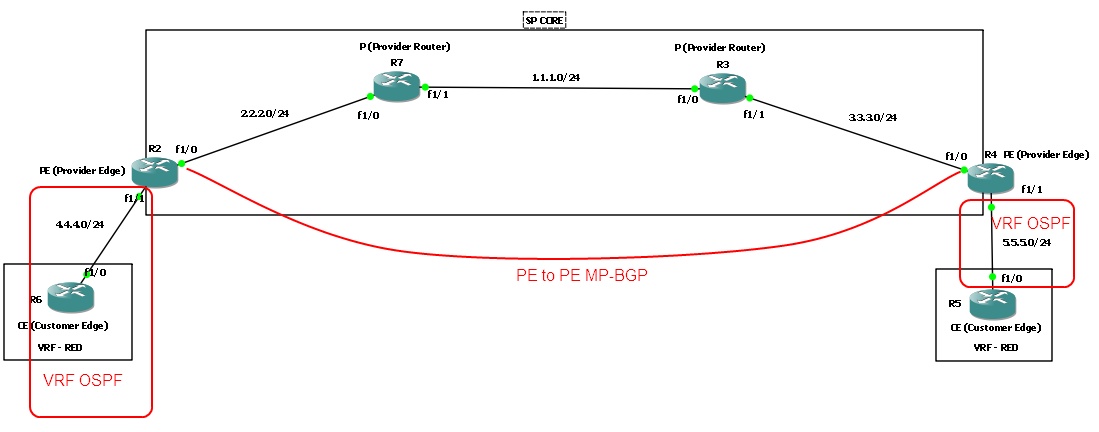
Consider this topology and let's get started.
Thursday, October 20, 2011
Configuring InterAS MPLS VPNs - CSC (Carriers Supporting Carriers)
In this blogtorial we will take a peek at how to configure InterAS MPLS. InterAS MPLS can be deployed to support customer sites traversing different SPs (Service Providers).
In this topology we will have 3 customer Sites. 2 of them connection to two different PEs routers in the same AS and another site connected to another PE router in a different AS.
Topology below and let's get started.
Relevant configurations are posted below.
In this topology we will have 3 customer Sites. 2 of them connection to two different PEs routers in the same AS and another site connected to another PE router in a different AS.
Topology below and let's get started.
Relevant configurations are posted below.
Friday, September 2, 2011
Configuring MPLS Traffic Engineering
In this blogtorial we are going to see how we can configure MPLS Traffic Engineering (MPLS TE). With MPLS TE we can achieve SONET (50ms) style failover between links and we can achieve this by creating backup tunnels and using fast re-route.
In this topology we will be configuring both explicit/static tunnels/paths and also dynamic auto-tunnels.
Consider the simple topology below and let's get started.
Relevant configurations are posted below.
In this topology we will be configuring both explicit/static tunnels/paths and also dynamic auto-tunnels.
Consider the simple topology below and let's get started.
Relevant configurations are posted below.
Wednesday, August 24, 2011
Configuring MPLS L2VPN InterAS VPWS - EoMPLS Port Mode
In this blogtorial I am going to show you a quick how-to on implementing L2VPN and more specifically Virtual Private Wire Service (EoMPLS Port Mode). VPWS can save money thus increasing the revenue for service providers because P2P circuits are usually more expensive. We are going to be configuring EoMPLS (Ethernet Over MPLS - Port Mode). Note: EoMPLS Modes - Port Mode, VLAN mode and VLAN Re-write mode. AToM (Any transport over MPLS) is sort of the umbrella which covers EoMPLS, FRoMPLS, and ATMoMPLS.
Consider the simple topology below.
Relevant configurations are posted below.
Consider the simple topology below.
Relevant configurations are posted below.
Thursday, August 11, 2011
Configuring MPLS L3VPNs
Imagine Site A-1 is in Georgia, A-2 is in Illinois and A-3 is in New York. Full connectivity between all Site A-#s is required. What are our options? Well you can do a full mesh VPN and using the formula n(n-1)/2 where n is the # of sites you can see that we would need to build 6 static VPN tunnels -- needless to say static tunnels are time consuming and does not scale well. Or you can set up DMVPN (Cisco proprietary) which would lessen the work. Or as an ISP we can provide MPLS VPN and the customers wont have to do ANYTHING which is just way they usually like it. Customer site Site A-#s and Customer Site B-#s can all be VPN'd together appropriately and transparently using MPLS.
Consider the topology below.
Objective:
Configure R1 and R2 to support MPLS/OSPF/BGP
Configure the appropriate VRFs on R1 and R2
All Site A routers (R3, R4 and R7) should all be able to transparently ping all Site-A#s loopbacks
All Site B routers (R5 and R6) should all be able to transparently ping all Site-B#s loopbacks
Site A routers (R3, R4, R7) should not be able to ping Site B routers (R5 and R6) and vice-versa
Relevant configurations are posted below. So let's jump right into the complex world of MPLS!!
Consider the topology below.
Configure R1 and R2 to support MPLS/OSPF/BGP
Configure the appropriate VRFs on R1 and R2
All Site A routers (R3, R4 and R7) should all be able to transparently ping all Site-A#s loopbacks
All Site B routers (R5 and R6) should all be able to transparently ping all Site-B#s loopbacks
Site A routers (R3, R4, R7) should not be able to ping Site B routers (R5 and R6) and vice-versa
Relevant configurations are posted below. So let's jump right into the complex world of MPLS!!
Subscribe to:
Posts (Atom)