Saturday, December 5, 2015

Configuring DMVPN Phase 1 w/ OSPF

In this blogtorial, we will configure DMVPN Phase 1 with OSPF and walk through some gotchas and some pitfalls to be on the look out for.

Due to the hierarchical nature of OSPF and other adjacency intricacies, OSPF is generally discouraged in a DMVPN design. 

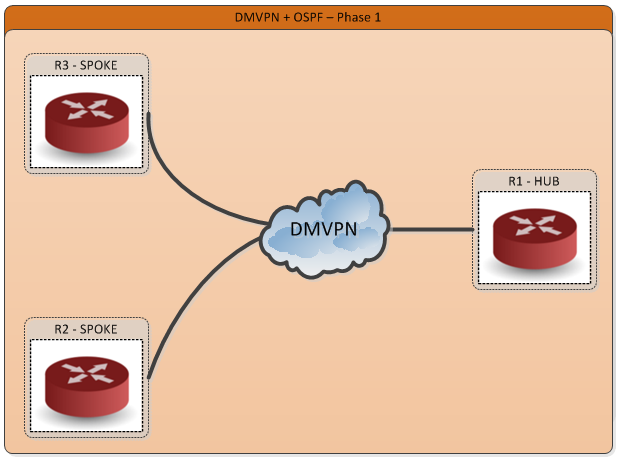
We are using the same topology as my previous blogtorial "Configuring DMVPN w/ IPSEC and EIGRP", however I'll post the base configs here as well. 

Here is our topology. 
Configuring DMVPN Phase 1 w/ IPSEC and EIGRP

In this blogtorial we will take a look at how to configure DMVPN, EIGRP over DMVPN and get the traffic going over the DMVPN encrypted using IPSEC. We will break the blogtorial in 3 parts. First we will configure the DMVPN / tunnel and verify end-to-end IP connectivity, then we will move on to configuring routing over the tunnel and finally get IPSEC configured to encrypt everything going over the tunnel.

Here is our topology.


Friday, December 4, 2015

Configuring IPSEC VTI (Virtual Tunnel Interfaces)

In this blogtorial, we will briefly explore how to configure IPSEC Virtual Tunnel Interfaces. One of the main advantages of Virtual Tunnel Interfaces is that you do not have to configure an ACL to match all "interesting traffic", thereby minimizing the number of IPSEC security associations (SAs) that must be created.

We'll use the same simple topology from my previous blogtorial "Configuring GRE over IPSEC w/ Routing".


Saturday, November 28, 2015

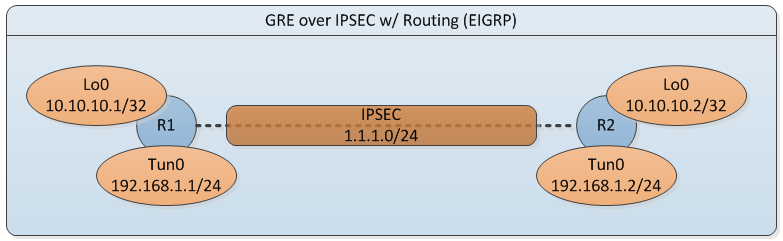
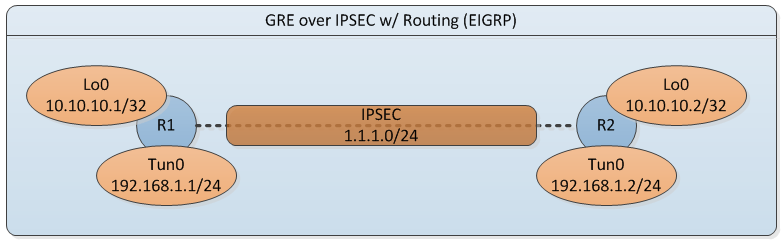
Configuring GRE over IPSEC w/ Routing (EIGRP)

In this blogtorial, we will briefly explore how to configure GRE tunnels over IPSEC with routing (EIGRP). In addition, we will take a closer look down at the packet level on how GRE interacts with IPSEC. Take a look at the simple topology below and let's get started.


Sunday, October 25, 2015

Configuring IPSEC VPN w/ Crypto Maps

In this blogtorial, we will set up a simple preshared key IPSEC VPN tunnel between two routers. We will also use the same topology for my next blogtorial 'Troubleshooting IPSEC VPN'. Lot's of debug and output posted with comments, see below. "Complexity is the enemy of security" therefore we will keep this a simple topology and get started.


Sunday, October 18, 2015

Decoding TimeStamping on Arista 7150

If you need a primer on 'How to configure PTP' on Arista click here. If you understand Arista's implementation of PTP then wait no further and read the rest of the blogtorial on how to decode them from a RAW packet capture.

Key frames DATA is 46bytes and is broken down as follows. What is in bold is important for calculating UTC time of a given packet.

8Bytes - ASIC Ticks
8Bytes - UTC in ns
8Bytes - LAST SYNC
8Bytes - KEY TS
8Bytes - EGRESS Interface DROPS
2Bytes - User defined DEVICE ID
2Bytes - Egress interface of the keyframe
1Byte - FCS TYPE
1Byte - RESERVED

Tuesday, May 19, 2015

Configuring BGP - Advertising default route to neighbors - default originate

This post is dedicated to my good friend / colleague Mr. Rage :) 

In this blogtorial we will explore one of the methods by which we can advertise a default route to BGP neighbors. One of my colleagues last week asked "would we loose the BGP default route advertisement if the advertising neighbor lost the default route in its own RIB" and honestly I wasn't sure. And I hate being unsure of "something" network related. So I did what any curious person would do, I lab'd it up and it turns out that default route advertisement is not lost when you loose the default route in the routing table, although you can certainly configure it as such.

Here is a simple topology to get started. 


Monday, May 18, 2015

TCP SACK Demystified

In this blogtorial, we will briefly explore TCP SACK (Selective Acknowledgement) option and the benefits of using TCP Selective Acknowledgement. TCP SACK is negotiated in the initial 3-way TCP handshake and both parties must agree to use this option or TCP SACK will not be permitted.

Let's walk through an example and observe what happens when SACK is not enabled.


Friday, May 1, 2015

BGP Wedgies - Demystified

Usually when we configure BGP we expect the network to converge correctly after all the peerings come up, however under rare circumstances this is not the case. In this blogtorial, we will explore one such corner case scenario in which depending on the order of operation, the BGP topology can end up in a unpredictable topology or a BGP Wedgie.

Here is the topology.


As usual let's go ahead and get the routers configured and give this topology a wedgie.

Thursday, April 16, 2015

Configuring Cisco - BGP Best External

In this blogtorial, we will briefly explore "BGP Best External" feature and walk through a scenario on how we can achieve sub-millisecond convergence with BGP. This feature is usually used in MPLS environment, although you can pretty much use it anywhere if the design allows it. Here is a simple topology so follow me.


Friday, April 10, 2015

What are TCP Spurious Retransmissions?

First time I saw on "TCP Spurious Retransmissions" on Wireshark, I had to look up the definition of Spurious on Google as I've never heard that word before :). It reads "not being what it purports to be; false or fake". Fake retransmissions? hmmm ... interesting ... started to wonder what this really means. After some investigation, I found out what these mysterious Spurious retransmissions really are. In Wireshark, TCP retransmissions are classified as one of three categories.

Key terms: 


RTO - Retransmission Timeout. Every TCP segment as it is sent to the IP layer has a timer associated with it and an ACK should be received before this timer expires. This timer is dynamically adjusted according to RTT and other factors. Here is a good write-up RFC 6298 if you want to get more information on how RTO is calculated. 

Thursday, April 9, 2015

Troubleshooting eBGP peering

Simple .... BGP topology ... can you get eBGP up and running between R1 and R2?

Objective:

Establish successful and stable eBGP relationship between R1 and R2. With the current start-up config, BGP is IDLE. 

Topology diagram and startup config are posted below.


Monday, April 6, 2015

Configuring OSPF - area range vs summary-address

In this blogtorial we are going to take a look at the difference between area range vs summary-address command both of which can be used for OSPF summarization/filtering. Both area range and summary-address commands can also be used for OSPF route filtering. In addition, we will also discuss a few options that are available with area range and summary-address command and pitfalls to be on the lookout for.

Simple topology below and let's get started.


Tuesday, March 24, 2015

Configuring OSPF - Summarization Lab

As the CCIE Lab exam requires you to the think outside the box a bit, I will do the same on this lab. Here is a simple topology and the basic start up configuration.

Objectives:

  • Summarize 192.168.1.2/32 from Area 2 as 192.168.1.0/24 into area 0.

Restrictions:

  • Do not use area-range command or summary-address to summarize the routes into Area 0.
  • R3 and other routers in Area 0 or any new additional areas should only have the summary address to reach 192.168.1.2. 
  • If prefix 192.168.1.2/32 is withdrawn (i.e shutdown loopback0 on R2) from R1 OSPF database then 192.168.1.0/24 should not be summarized/advertised into area 0.